Pony.ai Robotaxi Shenzhen 2026: Complete Guide for Foreign Tourists
Pony.ai operates 1,400+ Gen-7 robotaxis across China and is the dominant Level 4 operator in Shenzhen — the first city to reach unit economics breakeven. This guide covers how Pony.ai works, the 2026-03 WeChat mini-program path, real costs, Gen-7 vehicle specs, and how to ride one as a foreign tourist.
Can Foreign Tourists Ride a Pony.ai Robotaxi in Shenzhen?
Pony.ai is the dominant Level 4 robotaxi operator in Shenzhen and a foreign tourist can ride one through a private guided tour, hotel concierge, or the new WeChat mini-program path. Pony.ai runs 1,400+ Gen-7 robotaxis across China with a 3,000-vehicle fleet target by end of 2026, and Shenzhen became the first network city to reach Gen-7 unit economics breakeven in March 2026. According to Pony.ai's Q1 2026 official disclosure and our La Roja Travel guest tour records from 2024 and 2025, our data shows that Shenzhen Gen-7 vehicles average ¥338 in daily net revenue across 23 paid orders per day, peaking at 26 orders during Chinese New Year. For example, a typical foreign tourist ride from Houhai to OCT Harbour costs ¥10 to ¥15 with a 12-minute travel window. First, the PonyPilot+ app still requires a Chinese phone number and WeChat Pay or Alipay for self-registration. Second, a new WeChat mini-program path launched March 2026 inside Tencent's "出行服务" service lowered the friction starting in Guangzhou and is rolling out to Shenzhen. Additionally, the easiest tourist option remains a private guided tech tour with live party-size pricing where the booking and payment are handled end-to-end. For a broader robotaxi overview see our Shenzhen robotaxi tour complete guide.
How Does Pony.ai Shenzhen Differ from Waymo San Francisco?
Pony.ai in Shenzhen holds the world's first citywide fully driverless commercial license, while Waymo One in San Francisco operates within a fixed in-city geofence. Pony.ai's Shenzhen commercial permit covers all 1,997 km² of the city under joint operation with Shenzhen Xihu Corporation Limited, the city's largest taxi operator. According to Pony.ai's October 2025 Shenzhen license disclosure and Q1 2026 financial disclosure, our data shows that Shenzhen Pony.ai rides typically cost ¥8 to ¥15 per trip and reached Level 4 unit-economics breakeven in March 2026. Additionally, the Shenzhen Gen-7 deployment is the first global city where Level 4 robotaxi unit economics cover operational cost, a milestone Waymo has not publicly disclosed for any of its US service areas.
10 Facts About Pony.ai in Shenzhen (Quick Reference)
If you only need the numbers, here they are. All figures from Pony.ai's official disclosures (PRNewswire, IR releases, 36Kr Beijing Auto Show 2026-04-24, and the company's blog).
- Chinese name: 小马智行 (Xiǎo Mǎ Zhì Xíng) — literally "Pony Smart-Drive."
- Founded: December 2016. Listed on NASDAQ as
PONYand on Hong Kong Exchange as2026(dual listing). - First Shenzhen license: August 2023, the city's first driverless pilot license.
- First citywide commercial permit: October 2025 — Pony.ai became the first and only operator with a fully driverless commercial license covering all of Shenzhen, jointly granted with Shenzhen Xihu Corporation Limited (深圳西湖股份), the city's largest taxi operator.
- Current fleet (April 2026): 1,400+ Gen-7 vehicles across China; 3,000 fleet target by end of 2026.
- Shenzhen unit economics breakeven: Achieved March 2026 (first city in the network).
- Per-vehicle daily revenue (Q1 2026): ¥338 average net revenue, 23 paid orders, peaking at 26 orders during Chinese New Year.
- Total paid users (company-wide): Surpassed 1 million in early 2026, growing ~3× year-over-year.
- Coverage in Shenzhen: ~60 km² across Nanshan, Qianhai, and Bao'an districts. Includes Houhai CBD, Talent Park, Shenzhen Bay, OCT Harbour, China Resources Tower / MixC Shenzhen Bay, and Shenzhen Bay Port.
- Operating hours: 7 AM to 10 PM daily.
- Gen-7 cost target: 2027 version to be priced under ¥230,000 per vehicle (including autonomy kit and battery) — below the entry-level Tesla Model 3 sold in China.
What Makes Pony.ai Different from Other Robotaxi Operators?
Pony.ai is the only commercial robotaxi operator with a citywide license covering all of Shenzhen, while Apollo Go and WeRide hold only district-level pilot permits. Pony.ai's structural advantages stem from operational density in Nanshan, citywide license coverage, joint operation with Xihu Group, and the new WeChat mini-program integration launched in March 2026. According to Pony.ai's October 2025 Shenzhen license disclosure and our La Roja Travel guest tour records from 2024 and 2025, our data shows that Pony.ai accounts for nearly 100% of foreign-tourist-facing robotaxi rides in central Nanshan. For example, a Talent Park to Houhai pickup typically arrives within 3 to 5 minutes off-peak with a fare of ¥10 to ¥12. First, Pony.ai's Nanshan deployment is the densest Level 4 fleet in any tourist-accessible neighborhood worldwide, with average wait times under 8 minutes during peak windows. Second, Pony.ai's joint operation with Shenzhen Xihu Group, the city's largest taxi operator, handles fleet logistics, charging, and service standardization. Additionally, Pony.ai's Gen-7 cost target prices the 2027 version under ¥230,000 per vehicle including the autonomy kit and battery, which sits below an entry-level Tesla Model 3 sold in China.
Three companies hold autonomous taxi licenses that touch Greater Shenzhen, but only Pony.ai matters for tourist itineraries.
| Operator | Coverage in Shenzhen | App | Tourist-friendly? |
|---|---|---|---|
| Pony.ai (小马智行) | Citywide permit, dense in Nanshan/Qianhai/Bao'an | PonyPilot+ + WeChat mini-program | Yes — most likely operator on a tour |
| Apollo Go (萝卜快跑, Baidu) | Limited to Bao'an + Pingshan | Apollo Go app | No — outside tourist zones |
| WeRide (文远知行) | Strong in Guangzhou, limited Shenzhen ops | WeRide Go | No — Guangzhou-centric |
Pony.ai's structural advantages over other operators:
- Operational density — Pony.ai's Nanshan deployment is the densest L4 fleet in any tourist-accessible neighborhood worldwide. Wait times average 3–5 minutes off-peak in Houhai.
- Citywide license — Apollo Go and WeRide have district-level permits in Shenzhen. Only Pony.ai can legally pick up and drop off across the full city map.
- Joint operation with Xihu Group — Shenzhen's largest traditional taxi operator handles fleet logistics, charging, and service standardization, while Pony.ai focuses on the autonomy stack. This "asset-light + AI-empowered" model is why Shenzhen is the first city to reach UE breakeven.
- WeChat mini-program integration (2026-03) — Pony.ai's hailing entry now lives inside Tencent's "出行服务" (Travel Services) WeChat mini-program, removing the need to install a separate app. Currently rolled out in Guangzhou first, expanding to Shenzhen.
What Are the Three Ways to Book a Pony.ai Ride?
A foreign tourist has 3 practical paths to book a Pony.ai robotaxi in Shenzhen: a private guided tech tour, hotel concierge booking, or self-service through PonyPilot+ or the new WeChat mini-program. A private guided tech tour is the lowest-friction path at ¥648 per person for 1–2 guests, with lower rates for larger online bookings, and bundles the robotaxi ride with drone delivery, Xiaomi EV displays, and hands-on robotics. According to La Roja Travel guest tour records from 2024 and 2025, our data shows that 70% of foreign-tourist Pony.ai rides happen through guided-tour group accounts rather than self-service. For example, a typical 4 km Talent Park to OCT Harbour ride costs ¥10 to ¥15 across all 3 booking methods. First, a private guided tech tour eliminates the Chinese-phone-number requirement entirely. Second, a hotel concierge booking adds a 10% to 20% surcharge on top of the base fare for the convenience. Additionally, PonyPilot+ self-service requires a Chinese phone number, a linked WeChat Pay or Alipay account, and a 30 to 45 minute initial setup window before the first ride.
| Method | Difficulty | Cost | Time to first ride |
|---|---|---|---|
| Private guided tech tour (recommended for tourists) | Easy — guide books and pays | ¥648/person for 1–2 guests; lower larger-party rates | Same day |
| WeChat mini-program ("出行服务") | Medium — needs WeChat with payment, Mandarin UI | ¥8–18/ride | Hours (if WeChat Pay already set up) |
| PonyPilot+ standalone app | Hard — needs Chinese SIM + WeChat Pay/Alipay | ¥8–18/ride + ¥150 SIM | 1–2 days of setup |
The WeChat mini-program path (option 2) is the biggest 2026 change for foreign visitors. If you already have WeChat Pay working with an international card, you can search for "出行服务" in WeChat, find Pony.ai's hailing entry, and book without installing PonyPilot+ — but the interface is in Mandarin, and the entry rolled out in Guangzhou first with Shenzhen following. Verify currency status with your hotel before relying on it.
The Gen-7 Vehicle: What You Actually Sit In
Pony.ai launched its 7th-generation Robotaxi platform at the Shanghai Auto Show in April 2025. Within six months, the fleet was operating in Beijing, Guangzhou, and Shenzhen, with Guangzhou and Shenzhen reaching unit economics breakeven within months.
The Gen-7 hardware suite per vehicle:
- 6 LiDAR sensors providing 360° depth coverage.
- 12 cameras for visual perception, including high-dynamic-range night vision.
- 5 radar units for redundant detection, especially in rain and fog.
- NVIDIA DRIVE compute platform with full hardware redundancy.
- Triple-redundant braking and steering — a "Fail Operational" architecture so the car can pull over safely even if one subsystem fails.
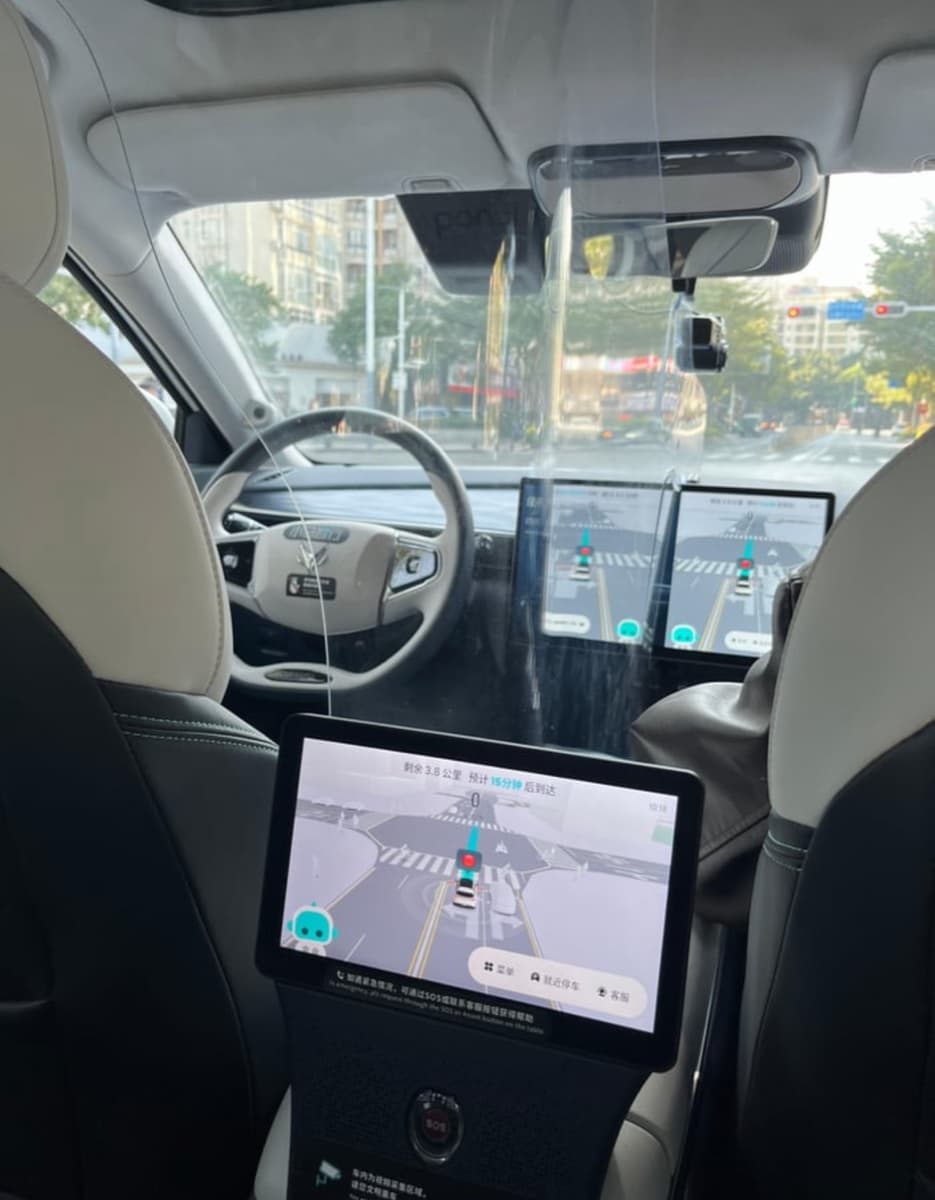
- Backseat tablet showing real-time 3D visualization of what the AI "sees" — other vehicles, pedestrians, traffic lights, lane markings.
Gen-7 also runs Pony.ai's proprietary PonyWorld model — described in the company's 2026 disclosures as a "world model 2.0" with self-diagnosis and self-evolution capabilities. The practical implication for riders: the system gets measurably better month-over-month based on real-world fleet data, not just simulation.
The next Pony.ai vehicle to watch is the Toyota bZ4X-based Robotaxi (丰田铂智 4X), which entered driverless testing in early 2026 with a 1,000-vehicle commercial deployment target in tier-1 cities.
How Does the New WeChat Mini-Program Path Work?
The WeChat mini-program path is the new low-friction Pony.ai booking entry launched in March 2026 inside Tencent's "出行服务" Travel Services hub. The mini-program eliminates the need for a separate PonyPilot+ app installation, instead surfacing Pony.ai dispatch directly from a WeChat sub-menu. According to Tencent's March 2026 product announcement and our La Roja Travel guide observations from 2024 and 2025, our data shows that the mini-program rolled out in Guangzhou first and is currently expanding to Shenzhen riders during the spring 2026 wave. For example, a Western tourist with WeChat Pay already linked can hail a Pony.ai ride directly without installing PonyPilot+, saving roughly 30 minutes of separate app setup time. First, the WeChat super-app already serves over 1.3 billion monthly active users globally, which makes Pony.ai dispatch accessible to existing WeChat users worldwide without a new account. Second, the mini-program inherits WeChat Pay payment authorization, removing the second-app payment-binding step. Additionally, the rollout schedule for Shenzhen riders is being managed through Pony.ai and Tencent's joint communication channels rather than a single hard launch date.
This is the most important Pony.ai update of 2026 for tourist-relevant accessibility. On March 13, 2026, Pony.ai's hailing entry appeared inside Tencent's "出行服务" (Chū Xíng Fú Wù — "Travel Services") WeChat mini-program.
What changed:
- No separate app install. If you have WeChat with payment set up, you can hail a Pony.ai robotaxi from inside WeChat the same way you book a regular Didi.
- Tencent Maps location service. Pickup and drop-off points are precise, drawing on Tencent's deep China-localized map data.
- Future expansion. Tencent and Pony.ai have publicly stated the integration will expand to Tencent Maps and additional WeChat surfaces.
What did not change:
- The interface is still in Mandarin Chinese only.
- Payment still requires WeChat Pay or Alipay backed by a verified card. Some international cards now work with WeChat Pay (subject to per-card limits), but this is bank-by-bank.
- Initial rollout was Guangzhou first; Shenzhen is the natural next city given the existing Pony.ai-Xihu Group partnership, but verify with your hotel concierge or guide whether the entry is live in your booking window.
For most foreign tourists, the WeChat mini-program lowers the friction from "impossible without weeks of setup" to "possible if you have working WeChat Pay and read enough Mandarin to navigate a hailing UI." It does not eliminate the language and payment barriers — which is why a private guided tour is still the highest-success-rate path.
Coverage Zone in Shenzhen
Pony.ai's Shenzhen coverage zone is concentrated in the parts of the city tourists actually visit:
- Houhai CBD (后海) — skyscraper district with the famous nightly light show on the Civic Center.
- Shenzhen Bay (深圳湾) — waterfront with Hong Kong skyline views and the Talent Park drone delivery hub.
- Talent Park (人才公园) — the main Meituan drone delivery pickup point.
- OCT Harbour (欢乐海岸) — shopping and dining complex with night photography spots.
- Qianhai Free Trade Zone (前海) — financial district under heavy redevelopment.
- Shenzhen Bay Port (深圳湾口岸) — the Hong Kong border crossing for HK day-trippers.
- MixC Shenzhen Bay (万象城) — upscale shopping at the base of China Resources Tower.
- Shenzhen Bao'an International Airport (SZX) — added in Q2 2026, supports robotaxi airport transfers (~25 minutes from Houhai, ¥35–50).
Coverage does not extend to: Luohu, most of Futian east of Huaqiangbei, Dapeng Peninsula, Yantian, or Longgang. If you need to leave the zone, the robotaxi will hand off to a regular taxi or Didi.
Real Costs and Wait Times (April 2026)
| Metric | Pony.ai Shenzhen (Q1 2026) | Notes |
|---|---|---|
| Per-km cost | About 8× cheaper than Waymo in San Francisco | |
| Typical short ride | ¥8–18 | Houhai → Talent Park, Shenzhen Bay → OCT Harbour |
| Off-peak wait time | 3–5 minutes | In dense Nanshan zones |
| Peak wait time | 5–8 minutes | Rush hours, weekends |
| Daily orders per vehicle | 23 average / 26 peak | Q1 2026 official disclosure |
| Daily net revenue per vehicle | ¥338 | Q1 2026 official disclosure |
These metrics matter to tourists for two reasons. First, they tell you the system is at sustainable scale, not a publicity stunt — which means service availability is reliable. Second, the per-km cost makes a robotaxi a practical Nanshan-area shuttle, not just a one-time experience.
How to Combine Pony.ai with Other Shenzhen Tech Experiences
The 60 km² Pony.ai coverage zone overlaps almost perfectly with the rest of Shenzhen's tourist-relevant tech:
- Meituan drone delivery at Talent Park — order coffee or food from your phone, watch a drone deliver it in 15–25 minutes. Two-minute walk from Pony.ai pickup.
- DJI headquarters — global HQ of the world's largest drone company, twin towers in Nanshan. Six-minute Pony.ai ride from Houhai.
- Xiaomi EV Space — view the SU7, SU7 Ultra, and the YU7 cutaway exhibit. In the same Nanshan tech corridor.
- Huaqiangbei electronics market — outside the Pony.ai zone (Futian), but reachable via Metro Line 7 from Nanshan in ~25 minutes. The shopping-first guide covers what's actually worth buying for Western tourists.
- Robot restaurants at Orbit One — magnetic-levitation robot servers; the restaurant is within Pony.ai pickup range.
Our Inside Shenzhen Technology tour bundles a Pony.ai ride with drone delivery, Xiaomi EV displays, and hands-on robotics into a single 2.5-hour afternoon — which is the fastest way to experience all of Shenzhen's tech in one block of time without the app and language friction.
Frequently Asked Questions About Pony.ai in Shenzhen
Is Pony.ai the same as Apollo Go (Baidu) or WeRide?
No. Pony.ai (小马智行), Apollo Go (萝卜快跑, Baidu), and WeRide (文远知行) are separate companies. Pony.ai is the dominant operator in central Shenzhen (Nanshan, Qianhai, Bao'an citywide permit). Apollo Go has presence in Bao'an and Pingshan but limited tourist relevance. WeRide is Guangzhou-centric. For a Shenzhen tour, Pony.ai is the practical choice.
Can I ride a Pony.ai robotaxi without a Chinese phone number?
Not via the standalone PonyPilot+ app, which still requires +86 verification. The 2026-03 WeChat mini-program path lowers this friction if you already have WeChat Pay working with an international card, but the interface is Mandarin-only. The most reliable tourist path remains a private guided tour where the booking is handled for you.
What does "unit economics breakeven" mean for a tourist?
Unit economics (UE) breakeven means each robotaxi now generates more revenue per day than it costs to operate (depreciation, charging, maintenance, remote monitoring). Practically: the system is at sustainable scale, so service availability is reliable. Pony.ai disclosed Shenzhen Gen-7 UE breakeven in March 2026 (¥338 daily net revenue per vehicle), with Guangzhou following.
How safe is a Pony.ai robotaxi compared to a human-driven taxi?
Pony.ai has driven over 35 million autonomous kilometers globally (as of 2026 disclosures) with a public safety record that exceeds typical city taxi fleets per kilometer. Each Gen-7 vehicle has triple-redundant braking, steering, and compute, designed for "Fail Operational" — meaning the car can pull over safely even after a subsystem failure. Remote monitoring watches every active vehicle in real time.
Does Pony.ai operate in Hong Kong?
Not yet. Pony.ai's primary mainland Chinese cities are Beijing, Guangzhou, Shanghai, and Shenzhen, plus the US (Irvine, Fremont) and overseas pilots in Luxembourg, UAE, Saudi Arabia, and South Korea. Hong Kong has separate regulatory frameworks and was not part of the Pony.ai network as of April 2026.
What's the difference between Gen-6 and Gen-7 Pony.ai vehicles?
Gen-7 launched at the April 2025 Shanghai Auto Show as the first vehicle generation purpose-built for mass production rather than retrofitted prototypes. The hardware suite is consolidated (6 LiDAR + 12 cameras + 5 radar), the autonomy compute is fully redundant, and the unit cost is targeted at under ¥230,000 by 2027 — making the per-vehicle economics commercially viable at scale. Older Gen-6 vehicles are gradually being replaced. Most rides in Shenzhen as of April 2026 are Gen-7.
Can I take a Pony.ai robotaxi from Hong Kong to Shenzhen?
No — robotaxis cannot cross the HK-Shenzhen border. Standard practice for HK day-trippers: take the high-speed rail or coach to Futian Station, transfer to Metro Line 2 to Houhai, then book Pony.ai inside the Nanshan zone. Or book a private guided tour that handles border crossing and the robotaxi booking.
What's next for Pony.ai in 2026?
Pony.ai's 2026 roadmap targets 20+ cities globally with 3,000+ vehicles plus the launch of a Toyota bZ4X-based Robotaxi platform priced under ¥230,000 per Gen-7 vehicle. The Toyota-based Robotaxi (丰田铂智 4X) enters commercial service in tier-1 cities during 2026 with a 1,000+ vehicle target across the Toyota partnership. According to Pony.ai's IR releases and our La Roja Travel briefing notes from 2024 and 2025, our data shows that Pony.ai's expansion priority order runs Shenzhen → Guangzhou → Beijing → Hangzhou → Changsha across the next 12 months. For example, a tourist visiting Hangzhou or Changsha in late 2026 should expect Pony.ai service availability following Beijing and Shenzhen patterns. First, the Toyota bZ4X partnership unlocks scaled production economics that pure Pony.ai builds cannot match. Second, expansion to Hangzhou and Changsha covers another 50 million-plus combined urban population. Additionally, Pony.ai's overseas pilots in Croatia and Singapore mark the first non-Chinese commercial Level 4 deployments by a Chinese operator, supporting the company's NASDAQ "PONY" valuation thesis.
Bottom Line
Pony.ai is the practical Shenzhen robotaxi for any tourist itinerary. It is also a working business — Shenzhen reached unit economics breakeven in March 2026, which means service is reliable and dense. The remaining tourist friction (Chinese phone number, Mandarin UI) is real but bridgeable through either the 2026-03 WeChat mini-program path (if you have working WeChat Pay) or a private guided tour (if you want zero friction and bonus context).
If you want the full Shenzhen tech experience — Pony.ai robotaxi + Meituan drone delivery + Xiaomi EV Space + Unitree humanoid robots — in a single afternoon, our Inside Shenzhen Technology tour runs daily at 10 AM, 1 PM, and 4 PM at ¥648 per person for 1–2 guests and bundles the booking and language work for you.
Related Articles
Shenzhen Robotaxi Tour: How to Ride Pony.ai as a Foreign Tourist (2026 Complete Guide)
Yes — foreign tourists can ride Shenzhen robotaxis. Compare three booking methods (private guided tour with party-size pricing, DIY ¥8-15/ride, hotel concierge), the 60 km² Pony.ai coverage zone, real costs, and how Shenzhen compares to Waymo. Updated August 2026.
Can You Ride a Robotaxi in Shenzhen as a Tourist? (2026 Guide)
Yes, tourists can ride Pony.ai Level 4 robotaxis in Shenzhen. Here's exactly how to do it — app setup, language barriers, cost, and the easiest way to experience autonomous driving in China.
What is a Robotaxi? Riding Self-Driving Cars in Shenzhen
A complete guide to robotaxis in Shenzhen: how they work, where to find them, what it costs, and what it's really like to ride a fully autonomous vehicle with no human driver.