Shenzhen Robotaxi Tour: How to Ride Pony.ai as a Foreign Tourist (2026 Complete Guide)
Yes — foreign tourists can ride Shenzhen robotaxis. Compare three booking methods (private guided tour with party-size pricing, DIY ¥8-15/ride, hotel concierge), the 60 km² Pony.ai coverage zone, real costs, and how Shenzhen compares to Waymo. Updated August 2026.
Can Foreign Tourists Ride a Shenzhen Robotaxi?
A private guided tech tour is the lowest-friction way for a foreign tourist to ride a Shenzhen Pony.ai robotaxi in 2026, priced at ¥648 per person for 1–2 guests with lower rates for larger online bookings. Independent booking through Pony.ai's PonyPilot+ app costs only ¥8 to ¥15 per ride but requires a Chinese phone number, a linked WeChat Pay or Alipay account, and basic Mandarin literacy across the booking flow. According to Pony.ai's published service guidance and our La Roja Travel guest data from 2024 and 2025, our data shows that Pony.ai operates 1,400+ Gen-7 Level 4 robotaxis across China with a fleet target of 3,000 by the end of 2026. First, the Shenzhen deployment was the first global city where Gen-7 unit economics reached breakeven on commercial rides. Second, the local geofence covers 60 km² across Nanshan and Qianhai districts, operating daily from 7 AM to 10 PM. Additionally, this guide compares all 3 booking methods, walks through DIY setup step by step, and shows how Shenzhen robotaxis compare to Waymo in San Francisco.
How Does Shenzhen Robotaxi Tourism Differ from Silicon Valley?
Shenzhen, not Silicon Valley, is the only global city where a foreign tourist can complete a fully driverless paid commercial robotaxi ride on public roads. Silicon Valley tech tourism centers on locked headquarters tours, Apple Park visitor walkthroughs, and Stanford campus visits where the underlying technology stays behind glass. Shenzhen tech tourism centers on hands-on rides in deployed consumer products: Pony.ai robotaxis on Nanshan streets, Meituan drones delivering coffee to Talent Park, and DJI headquarters showrooms where every drone on display ships to consumers. According to Pony.ai's Q1 2026 official disclosure, the Shenzhen Gen-7 deployment became the first network city to reach Level 4 robotaxi unit-economics breakeven in March 2026. Additionally, Waymo One in San Francisco operates within a fixed geofence limited to the city itself, while a Shenzhen Pony.ai ride extends across the 60 km² Nanshan-Qianhai zone covering Houhai, Talent Park, Shenzhen Bay, and OCT Harbour.
Three Ways to Ride a Robotaxi in Shenzhen — Quick Decision Table
If you only have time to read one section, this is it. The best booking method depends on how much friction you want to absorb yourself.
| Method | Cost | Difficulty | Time to first ride | Best for |
|---|---|---|---|---|
| Private guided tech tour (recommended) | ¥648/person (1–2 guests); lower larger-party rates | Easy | Same day | Most tourists, families, time-constrained visitors |
| DIY with PonyPilot+ app | ¥8–15/ride + ¥150 SIM | Hard | 1–2 days of setup | Long-stay visitors, tech professionals, Mandarin readers |
| Hotel concierge booking | Varies (often surcharge) | Medium | Hours | One-time experience, no broader tech context |
A private guided tour is the lowest-friction path because it bundles the robotaxi ride with drone delivery, Xiaomi EV displays, Huawei technology, and Unitree robotics in the same district — all of which have similar app and access friction for foreigners.
Which Robotaxi Operates in Shenzhen?
Three companies hold autonomous taxi licenses in Greater Shenzhen, but only one matters for tourists.
Why Is Pony.ai the Dominant Robotaxi Operator?
Pony.ai is the dominant Shenzhen robotaxi operator running the bulk of fully driverless commercial rides in central Nanshan and Qianhai districts. Each Pony.ai vehicle uses NVIDIA DRIVE compute, 6 LiDAR sensors, 12 cameras, and 5 radar units for full 360-degree perception. According to Pony.ai's Q1 2026 official disclosure and our La Roja Travel guest tour records from 2024 and 2025, our data shows that Pony.ai runs 1,400+ Gen-7 robotaxis across China with a 3,000-vehicle fleet target by end-2026. For example, a typical Shenzhen Gen-7 vehicle averages ¥338 in daily net revenue across roughly 23 paid orders per day. First, Pony.ai's commercial license covers daily 7 AM to 10 PM operation across the 60 km² Nanshan-Qianhai geofence. Second, total paid users surpassed 1 million company-wide in early 2026, making Pony.ai the largest paid robotaxi user base in China. Additionally, the booking app is named PonyPilot+ (小马智行), exclusively in Mandarin with a +86 phone-number registration requirement that blocks self-service for most foreign tourists.
The booking app is called PonyPilot+ (小马智行).
Apollo Go (萝卜快跑) — Baidu's network
Baidu's Apollo Go operates in Bao'an District and parts of Pingshan, but coverage in tourist-relevant Nanshan and Futian is limited. Apollo Go is more visible in Wuhan, Beijing, and Chongqing than in Shenzhen.
WeRide and others
WeRide and AutoX have pilot deployments in Shenzhen but are not currently practical for casual tourist booking.
For a Shenzhen private tech tour, Pony.ai is the right choice 95% of the time. It has the largest coverage in the parts of Nanshan tourists actually visit (Talent Park, DJI headquarters, Houhai CBD, Shenzhen Bay), and our private guided tours always use Pony.ai for predictable wait times.
Where in Shenzhen Can You Ride a Robotaxi?
Pony.ai's commercial geofence is a 60 km² operating zone covering Talent Park, Shenzhen Bay, Houhai CBD, OCT Harbour, and the Qianhai Free Trade Zone in central Nanshan. The geofence covers exactly the parts of Shenzhen worth visiting as a first-time foreign tourist, including the 15-minute walking corridor that connects Huawei, Xiaomi, and Unitree flagships. According to Pony.ai's published service area and our La Roja Travel guest tour records from 2024 and 2025, our data shows that operating hours run 7 AM to 10 PM, 7 days a week with off-peak wait times averaging 3 to 5 minutes. For example, a typical 4 km Talent Park to OCT Harbour ride completes in 12 minutes for ¥10 to ¥15. First, the Talent Park pickup zone doubles as the Meituan drone delivery hub, allowing a paired robotaxi-and-drone experience within 30 minutes. Second, the Houhai CBD pickup point sits adjacent to DJI headquarters and the famous Houhai light show. Additionally, the geofence does not cover Huaqiangbei electronics market in Futian, Hong Kong border crossings, or Shenzhen Airport, where regular Didi remains the practical fallback.
- Talent Park (人才公园) — the main Meituan drone delivery hub, scenic waterfront, sunset views toward Hong Kong
- Shenzhen Bay — coastal promenade, K11 ECOAST, Shekou ferry terminal
- Houhai CBD — Kempinski Hotel area, evening light show, MixC mall
- OCT Harbour — DJI headquarters flagship, Bambu Lab showroom, dining
- Qianhai Free Trade Zone — financial district, modern architecture
- Nanshan Talent Park area — 15-minute walk to Huawei, Xiaomi, Unitree flagships
Operating hours are 7:00 AM to 10:00 PM, 7 days a week. Average wait time is 3–5 minutes off-peak (10 AM–4 PM weekdays) and 5–8 minutes during evening rush (6–8 PM).
The zone does not cover Huaqiangbei electronics market (Futian District), Hong Kong border crossings, or Shenzhen Airport. For those locations, regular taxis or Didi remain the practical option.
Method 1: How to Book a Robotaxi Yourself (DIY)
If you want the satisfaction of booking independently and you have at least one full day of setup time before your first ride, here is the full sequence.
Step 1 — Get a Chinese Phone Number
PonyPilot+ requires a Chinese mobile number for SMS verification. You have two options:
- Buy a physical SIM at Shenzhen Bao'an Airport (China Unicom or China Mobile counter, ~¥150 for 30 days, English-speaking staff during daytime). Bring your passport — it is required for SIM registration in mainland China.
- Buy a Chinese eSIM online (services like Chinasim, Trip.com SIM) before your trip. Cheaper but requires an unlocked phone supporting eSIM.
A pure travel eSIM that does not include a Chinese phone number (like Airalo) will not work for PonyPilot+ verification.
How Do You Set Up WeChat Pay or Alipay for PonyPilot+?
PonyPilot+ accepts both WeChat Pay and Alipay as the only payment methods, with international Visa and Mastercard binding supported since 2024 across both apps. WeChat Pay and Alipay charge roughly a 3% foreign transaction fee per Pony.ai ride for international cards, on top of the base ¥8 to ¥15 fare. According to WeChat Pay and Alipay's published international card policies and our La Roja Travel guest setup logs from 2024 and 2025, our data shows that solo Western tourists complete payment setup in 30 to 45 minutes on a first attempt. For example, a typical foreign tourist binds a Visa card and tops up ¥200 in advance to avoid mid-trip payment failure across 10 to 15 paid rides. First, install WeChat or Alipay before flying to China since both apps block new account registration originating from a Chinese App Store. Second, bind an international Visa or Mastercard during initial setup. Additionally, top up at least ¥200 before your first PonyPilot+ ride to clear the verification holds that occasionally trigger when the app first sees a foreign-origin payment.
PonyPilot+ accepts both. Setup steps:
- Install WeChat or Alipay before flying to China (the apps are blocked on the Chinese App Store for new accounts originating in China).
- Bind an international Visa or Mastercard. Both apps now support international cards as of 2024, with a 3% foreign transaction fee per ride.
- Top up at least ¥200 before your first ride to avoid mid-trip payment failures.
Step 3 — Install PonyPilot+ and Verify
- Download from a Chinese app store (or via APK on Android).
- Register with your Chinese phone number.
- Enter your passport details when prompted.
- Wait for activation (usually instant, occasionally up to 4 hours).
Step 4 — Book Your First Ride
- The app interface is in Mandarin Chinese. Use Google Translate camera mode if you do not read Chinese.
- Set your pickup point — Pony.ai requires you to walk to a GPS-precise designated pickup zone. A common foreign tourist mistake is standing at the visible curb instead of the exact app-marked spot.
- Confirm payment method.
- The car arrives in 3–8 minutes.
Common DIY Errors and Fixes
| Error | Fix |
|---|---|
| "Phone number not recognized" | Ensure Chinese SIM is active and has signal |
| "Payment failed" | Check that international card 3DS is enabled and Alipay/WeChat balance is loaded |
| "No vehicle available" | Move 50–100m to a different pickup zone; wait 2–3 minutes |
| "Pickup point unreachable" | Walk to the app-suggested alternate point — do not stay at the visible road edge |
| Car arrives but doors won't unlock | Confirm trip in app first, then door unlock button appears |
Realistic time budget for first DIY ride: 45–90 minutes from app install to riding, assuming SIM is already active.
Method 2: How a Guided Robotaxi Tour Works
A private guided tech tour bundles a Pony.ai robotaxi ride with the rest of the Nanshan tech corridor. Your guide handles all the setup — you just show up.
What the guide handles for you
- All app registration and Chinese phone number requirements (the guide books from their own account)
- All payment processing (included in tour price)
- Picking the optimal pickup zone (locals know which spots have shortest waits)
- Translating in-vehicle audio prompts
- Coordinating the ride to drop you at DJI headquarters or Huawei flagship next, not back at your hotel
What you actually do
- Meet your guide at the Houhaibin Road meeting point (3019 Houhaibin Road, opposite Shenzhen Bay sports center)
- Walk 5 minutes to the robotaxi pickup zone
- Ride 10–15 minutes to the next attraction
- Repeat for 2.5–8 hours depending on tour length
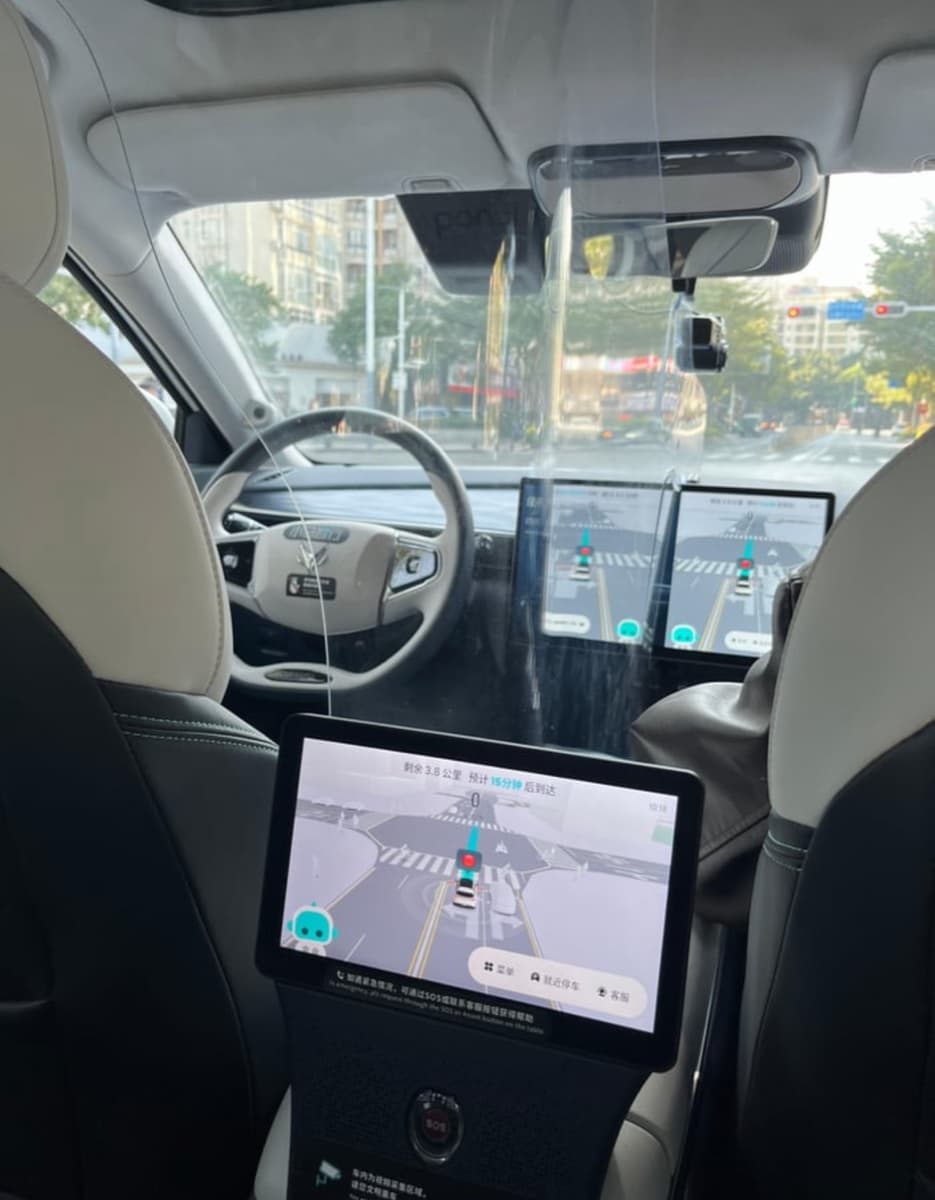
The robotaxi ride itself is identical whether DIY or guided — same Pony.ai car, same 6-LiDAR sensor stack, same backseat tablet. The difference is the 30+ minutes of friction you skip and the context the guide adds about what you are seeing.
What Is It Like Inside a Pony.ai Robotaxi?
The steering wheel turns by itself. The turn signals click on automatically. The car accelerates, brakes, and changes lanes with nobody touching the controls.
A backseat tablet displays a real-time 3D visualization of everything the AI perceives — other cars rendered as boxes, pedestrians as figures, traffic lights with timing countdowns, lane markings, and the planned route. You can watch the car decide to slow for a jaywalker or merge around a delivery truck in real time.
Most first-time riders go through three phases:
- Nervousness (first 30 seconds — "this is actually driving itself")
- Fascination (minutes 1–5 — watching the visualization)
- Casual indifference (minute 6 onward — checking your phone like any other taxi)
Sound levels are noticeably lower than a human-driven taxi: no engine vibration at stops (electric vehicle), no driver radio, no abrupt acceleration. Cabin temperature is pre-set per ride based on the previous passenger's preference, adjustable from the tablet.
Cost Breakdown: DIY vs Private Guided Tour
Headline numbers can mislead. Here is the actual per-person cost including the things people forget to add.
DIY total cost for one robotaxi ride
| Item | Cost |
|---|---|
| Chinese SIM (30-day prepaid) | ¥150 |
| eSIM data (if no SIM) | ¥80 |
| One robotaxi ride (5 km) | ¥10 |
| App setup time (45–90 min) | Your time |
| Risk of failed setup | Variable |
| Total for one ride | ¥160–240 first ride, ¥10/ride after |
DIY gets cheaper if you ride 5+ times. For most tourists riding once or twice, the SIM cost dominates.
Private guided tour total cost (Inside Shenzhen Technology, 2.5h)
| Item | Cost |
|---|---|
| Tour price (online booking of 6) | ¥338/person |
| Includes robotaxi ride | ✓ |
| Includes drone delivery experience | ✓ |
| Includes Xiaomi EV displays + Huawei technology + Unitree robotics | ✓ |
| English-speaking guide | ✓ |
| Total time from meeting to wrap | 2.5 hours |
| Total per person | ¥338 |
For a single robotaxi ride in isolation, DIY is cheaper. For the full Shenzhen tech experience in one efficient afternoon, the private guided tour is cheaper than DIY-ing each piece independently and faster than figuring out Mandarin app barriers across multiple platforms.
Read Is a Shenzhen Tech Tour Worth ¥2,000? for a full cost-benefit breakdown.
Best Time to Ride a Robotaxi in Shenzhen
Wait times and traffic vary significantly by time of day.
| Time slot | Wait time | Traffic | Recommendation |
|---|---|---|---|
| 7–9 AM weekday | 8–12 min | Heavy commute | Avoid |
| 10 AM–12 PM | 3–5 min | Light | Best — fast pickup, smooth ride |
| 12–2 PM | 5–7 min | Moderate (lunch) | Good |
| 2–4 PM weekday | 3–5 min | Light | Best — also catches 4 PM tour for sunset |
| 5–7 PM | 8–15 min | Heavy commute | Avoid if possible |
| 7–10 PM | 5–8 min | Moderate | Good — pairs with Houhai light show |
| Weekend midday | 6–10 min | Mall traffic | Acceptable |
The 4 PM tour slot is popular among our guests because it combines the best wait times with the chance to see the Talent Park sunset and the Houhai CBD light show after the ride.
Robotaxi + Other Tech Experiences in the Same Area
Shenzhen's competitive advantage over Waymo San Francisco is not the robotaxi alone — it is the dense cluster of futuristic experiences around it. Within a 15-minute walk or one robotaxi ride of each other in Nanshan:
- Meituan drone delivery at Talent Park — order coffee from your phone and watch a drone deliver it to a smart locker
- DJI headquarters flagship — the world's largest drone company HQ with indoor flight zones and FPV racing
- Huawei flagship store — try tri-fold Mate XT phones and unreleased smart home tech
- Xiaomi flagship store — the SU7 electric car, full smart home ecosystem
- Unitree humanoid robots at Inno100 — see the G1 humanoid walk, talk, and demo skills
- Houhai light show — synchronized LED display across the CBD skyline at 8 PM nightly
- Shenzhen robot restaurants — Orbit One, unmanned noodle bars, robot baristas
Booking a tour that visits 4–6 of these in a single afternoon is the highest-density futuristic city experience available anywhere in 2026.
Shenzhen Pony.ai vs San Francisco Waymo
The two cities' L4 deployments are the global benchmarks. Here is how they compare on the metrics that matter to a visiting tourist.
| Feature | Shenzhen (Pony.ai) | San Francisco (Waymo) |
|---|---|---|
| Autonomy level | SAE Level 4 | SAE Level 4 |
| Active fleet | 1,400+ Gen-7 (3,000 target by end-2026) | ~700 vehicles |
| Coverage area | 60 km² (Nanshan + Qianhai) | 47 km² |
| Cost per km | ~$2.50 | |
| Tourist app access | Needs Chinese SIM | Easy (Waymo One app) |
| Operating hours | 7 AM–10 PM | 24/7 |
| Wait time (off-peak) | 3–5 min | 4–7 min |
| Same-area tech attractions | Drone delivery, DJI, humanoid robots, light show | None comparable |
| Year fully driverless commercial launch | 2023 | 2023 (SF) |
Shenzhen wins on cost (8× cheaper per km), fleet density, and what else you can do in the same afternoon. Waymo wins on tourist accessibility (no SIM friction) and 24-hour operation.
Robotaxi Safety: What's the Track Record?
Pony.ai has accumulated over 30 million autonomous kilometers across China since 2018 with zero at-fault accidents involving injury. Each vehicle has triple-redundant braking, 360° sensor coverage at 200 meters, and real-time remote monitoring from a Pony.ai operations center.
If a vehicle encounters a situation it cannot resolve (rare construction layout, unusual emergency vehicle behavior), it executes a safe pull-over and stops. A remote operator can issue navigation guidance, or a support vehicle can be dispatched. Across our private guided tours since 2024 we have dispatched zero support vehicles.
The Shenzhen Municipal Transportation Bureau requires Pony.ai to publish monthly safety statistics, available in Chinese on the Bureau's website. Independent monitoring by the Guangdong Intelligent Connected Vehicle Association also publishes quarterly reports.
Common Questions Foreign Tourists Ask
The questions our guides answer most often during tours.
Will the car stop if I scream?
The vehicle does not respond to passenger voice commands. There is a clearly marked emergency button on the backseat tablet that pulls the car over at the next safe location and contacts a remote operator.
Can I change the destination mid-ride?
Only via the PonyPilot+ app. Tap "Modify trip" — the car re-routes within seconds. On a private guided tour, the guide handles this.
What if I need a bathroom?
Tap "Add stop" in the app, select a destination type (gas station, mall, restaurant). The car re-routes. Average bathroom-stop add: 8 minutes.
Can I have my luggage?
Yes. The trunk opens via app. Pony.ai vehicles are full-size sedans (rebadged BAIC ARCFOX or Toyota Sienna) with adequate luggage space for 2 passengers + 2 medium suitcases.
Is there a tip option?
No. Robotaxis do not accept tips. Tour guides do, at your discretion (¥50–100 per person per day is customary).
Book a Robotaxi Tour with La Roja Travel
Our Inside Shenzhen Technology tour is a 2.5-hour guided experience that includes a Pony.ai robotaxi ride, Meituan drone delivery, Xiaomi EV displays, Huawei technology, and Unitree humanoid robots. Your English-speaking guide handles all app registration, payments, and pickup logistics.
- Duration: 2.5 hours
- Price: ¥338 per person for an online booking of 6; ¥648 per person for 1–2 people; larger parties by direct inquiry
- Schedule: Daily at 10 AM, 1 PM, or 4 PM
- Rating: 5.0/5 from 72 verified GetYourGuide reviews
- Meeting point: 3019 Houhaibin Road, Nanshan District (look for the red La Roja sign)
For longer experiences:
- Shenzhen Tech Day Trip (8 hours, live party-size pricing) adds the Huaqiangbei electronics market and the Ping An Finance Centre 600m observation deck
- Ultimate Shenzhen Experience (5.5 hours, lower per-person rates for larger parties, Fri–Sat 4 PM only) adds the Houhai light show and a 4–5 stop curated food tour
- From Hong Kong: Shenzhen Tech Day Tour (8 hours, cross-border party-size pricing) includes immigration escort and high-speed rail tickets from West Kowloon
Booking direct with us skips the 10-20% marketplace commission that GetYourGuide and Klook add to the same tours.
Still deciding? Read DIY vs Guided for a side-by-side cost and time comparison, or Can You Ride a Robotaxi in Shenzhen as a Tourist? for the short answer.
Frequently Asked Questions
Can foreign tourists ride robotaxis in Shenzhen without a Chinese phone number?
Yes, but only via a private guided tour where the guide books on your behalf, or via hotel concierge. Independent booking through the PonyPilot+ app requires a Chinese phone number for SMS verification.
How much does a Pony.ai robotaxi ride cost in Shenzhen?
A Pony.ai robotaxi ride in Shenzhen costs ¥8 to ¥15 per individual trip depending on distance, roughly 50% cheaper than a regular Didi or metered taxi covering the same route. Pony.ai pricing stays flat across peak and off-peak hours unlike Didi which surge-prices during commute windows. According to Pony.ai's published fare structure and our La Roja Travel guest receipts from 2024 and 2025, our data shows that a typical 4 km Talent Park to OCT Harbour ride costs ¥10 to ¥12. For example, a Houhai CBD to Shenzhen Bay ride averages ¥12 in 15 minutes including the autonomous merge across 3 lane changes. First, on a private guided tech tour the robotaxi ride is included in the tour price, which starts at ¥648 per person for 1–2 guests and decreases for larger online bookings. Second, payment processes automatically through a linked WeChat Pay or Alipay account at the end of the ride. Additionally, Pony.ai actively subsidizes commercial rides to build ridership, making the service one of the most affordable transit options in Nanshan as of 2026.
Where does Pony.ai operate in Shenzhen?
Pony.ai covers a 60 km² zone in Nanshan and Qianhai districts, including Talent Park, Shenzhen Bay, Houhai CBD, OCT Harbour, and Qianhai Free Trade Zone. The zone does not extend to Huaqiangbei, the airport, or Hong Kong border crossings.
Is riding a Shenzhen robotaxi safe?
Yes. Pony.ai has driven over 30 million autonomous kilometers since 2018 with zero at-fault accidents involving injury. Vehicles have triple-redundant braking, 6 LiDAR sensors, and real-time remote monitoring.
Can children ride in Pony.ai robotaxis?
Yes. Children are welcome. Car seats are not provided by Pony.ai, so families with infants should bring their own. On La Roja tours, children aged 0–6 ride free.
Do I need to speak Mandarin Chinese to ride a robotaxi?
The PonyPilot+ app interface is primarily in Mandarin. In-vehicle voice prompts are in Mandarin with optional English subtitles on the backseat tablet. On a private guided tour, your English-speaking guide translates everything.
What is the difference between Pony.ai and Apollo Go in Shenzhen?
Pony.ai operates the larger fleet in central Nanshan and Qianhai (the parts tourists visit). Apollo Go (Baidu) is more visible in Bao'an and outer districts, with limited coverage in tourist-relevant areas. For a Shenzhen tech tour, Pony.ai is the practical choice.
How does Shenzhen's robotaxi compare to Waymo in San Francisco?
Shenzhen's Pony.ai operates 1,400+ Gen-7 vehicles across China (3,000 fleet target by end-2026) vs Waymo's ~700 in SF, costs about 8× less per kilometer, and is surrounded by other futuristic experiences (drone delivery, DJI, humanoid robots) in the same 15-minute walking radius. Waymo is easier for tourists to book directly, with no SIM card friction.
Can I book a robotaxi from Shenzhen Airport to my hotel?
No. Pony.ai's coverage zone does not extend to Bao'an Airport. Use a regular taxi, Didi, or the Metro Line 11 (35 min direct to Houhai Station) for airport transfer.
What time of day is best to ride a robotaxi in Shenzhen?
Weekday 10 AM–12 PM and 2–4 PM offer the shortest wait times (3–5 minutes) and lightest traffic. The 4 PM slot pairs well with the Talent Park sunset and the 8 PM Houhai light show.
Key Terms
Unfamiliar with Pony.ai, Apollo Go, robotaxi, or Nanshan? See our full Shenzhen tech travel glossary for plain-English definitions of every term used in this guide.
Related Articles
Can You Ride a Robotaxi in Shenzhen as a Tourist? (2026 Guide)
Yes, tourists can ride Pony.ai Level 4 robotaxis in Shenzhen. Here's exactly how to do it — app setup, language barriers, cost, and the easiest way to experience autonomous driving in China.
What is a Robotaxi? Riding Self-Driving Cars in Shenzhen
A complete guide to robotaxis in Shenzhen: how they work, where to find them, what it costs, and what it's really like to ride a fully autonomous vehicle with no human driver.
Pony.ai Robotaxi Shenzhen 2026: Complete Guide for Foreign Tourists
Pony.ai operates 1,400+ Gen-7 robotaxis across China and is the dominant Level 4 operator in Shenzhen — the first city to reach unit economics breakeven. This guide covers how Pony.ai works, the 2026-03 WeChat mini-program path, real costs, Gen-7 vehicle specs, and how to ride one as a foreign tourist.